
Many people assume that once you start a peptide, results are just a matter of waiting it out. That’s not really how it works. I’m not here to talk you out of anything, and if you’ve already decided you’re trying a peptide, whatever’s driving that decision is yours, not mine to argue with. What I can do is tell you what the evidence actually says about when, and whether, you’ll see results, because the gap between what sellers promise and what’s been measured in humans is where people get hurt, or at least get ripped off.
No brand pays for space here. Nothing on this page links to a checkout. The only outbound links go to things you can check yourself: the FDA’s enforcement record, the trial papers on PubMed, and StatPearls. Keep that in mind when you read anything else on this topic, because most of what’s out there does have money behind it.
Here’s the deal up front: this category splits cleanly into two piles. One pile has actual human trials with actual measured timelines. The other pile has none. Nobody selling you the second pile is going to volunteer that distinction, so I will.
The pile with real numbers: semaglutide, tirzepatide, retatrutide
These are peptides too, even though people don’t always file them mentally next to BPC-157 or TB-500. They work through the incretin system, dialing down glucagon, slowing how fast your stomach empties, making you feel full longer [C6]. Because they went through large randomized trials with scheduled check-ins, we can actually draw a calendar for them.
Semaglutide 2.4 mg, in the STEP 1 trial, got people to roughly 15% mean weight loss over 68 weeks, against about 2.4% on placebo [C5]. Read that denominator again: 68 weeks. That’s not a first-month number, it’s more than a year of gradual dose increases before you hit the headline figure. Nobody drops that much weight in the first three weeks on this stuff, and if someone’s telling you otherwise, they’re selling you a story.
Tirzepatide, in SURMOUNT-1, ran 72 weeks and landed mean reductions between 15.0% and 20.9% depending on dose, versus 3.1% on placebo [C4]. Same lesson. The impressive number is an end-of-trial number, reached slowly, on purpose, with the dose titrated up over time so your body isn’t blindsided.
Retatrutide, still investigational and not approved for anyone to actually take outside a trial, hit around 17.5% mean weight loss at 24 weeks in its Phase 2 [C7]. It’s not something you can currently get prescribed, but it’s worth knowing the pattern holds even here: real number, real window, nothing overnight.
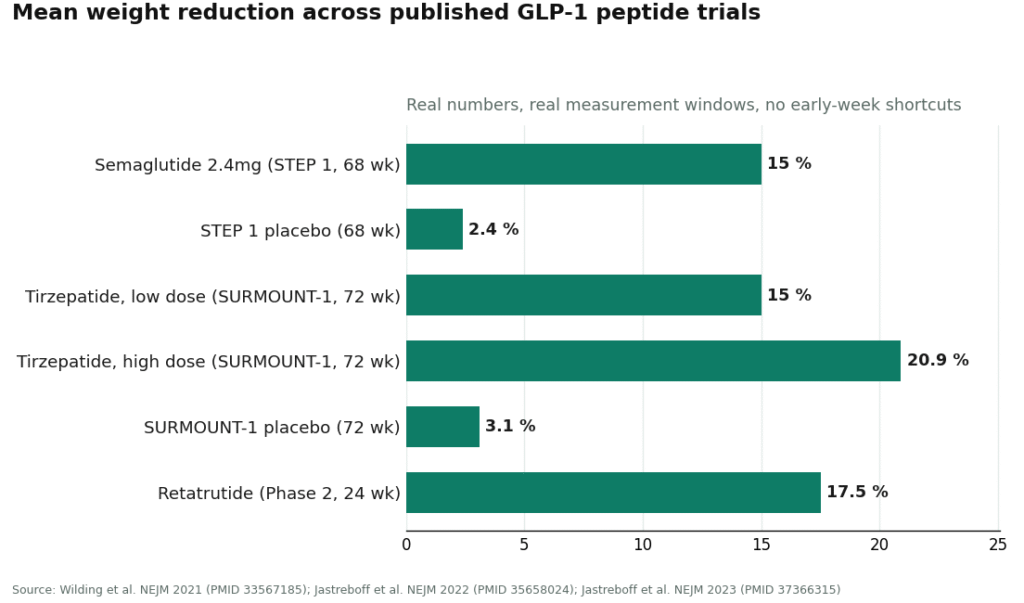
If you’re on one of these under supervision, expect a slow burn measured in months, not a flash. That’s not me being cautious for the sake of it, that’s literally what the trials measured.
The pile with nothing in it: BPC-157 and most of what research-chemical sites sell
Here’s the part that actually matters for harm reduction, because this is where the real risk concentrates.
Take BPC-157, probably the single most-bought compound in this whole space. A 2025 systematic review went through 544 articles, kept 36, and found that 35 of those were animal or lab studies. One was a small human study. The reviewers found no clinical safety data in humans at all [C3]. Not “limited,” not “early-stage.” None.
That means there is no honest timeline to give you. There’s no trial where researchers checked in at week 4, week 8, or week 12 and wrote down what happened. So when a product page tells you “most people notice results in two to four weeks,” that sentence didn’t come from data. It came from marketing copy wearing a lab coat.
I want to be blunt about what this means for you if you use it anyway: you’re not just missing a results timeline, you’re missing a safety timeline too. Nobody has published when side effects tend to show up, what a concerning reaction looks like at week two versus week eight, or what a safe upper bound on duration is. The same absence of data that keeps sellers from giving you an honest “when will I feel it” also keeps them from giving you an honest “when should I worry.” That’s the real cost of buying into the unevidenced pile, and it’s rarely spelled out that plainly.
If you’re doing this anyway: the safer path
I’m not going to pretend the safest option is “don’t.” You already know that one. Here’s what actually reduces risk if you’re moving forward regardless:
Know which pile you’re in. If it’s semaglutide or tirzepatide, you’re standing on real trial data, and a slow, titrated, months-long process is what you should expect and plan for financially and physically. If it’s BPC-157 or most other research-chemical catalog items, you are, by definition, an uncontrolled experiment of one. That’s not a moral judgment, it’s just accurate.
Get bloodwork before and during, regardless of the compound. If nobody’s published a safety monitoring schedule for what you’re taking, you have to build your own. Baseline labs, then periodic checks, are the closest thing to a safety net you can construct yourself when the literature hasn’t done it for you.
Be skeptical of any confident timeline on a product page, especially for anything sold “research use only.” In September 2025, regulators documented more than fifty FDA warning letters targeting exactly this kind of marketing, compounded GLP-1s and research peptides including semaglutide, tirzepatide, retatrutide, BPC-157, and certain SARMs, where the advertising suggested human use despite the “not for human consumption” label [C2]. Then on March 31, 2026, the FDA sent warning letters to sellers including Gram Peptides, Prime Sciences, and Pink Pony Peptides, stating flatly that “evidence obtained from your website establishes that your products are intended to be drugs for human use” [C1]. A confident weeks-to-results claim on one of these sites isn’t a clinical finding. It’s the exact thing the agency is currently going after.
If you want a floor under you, that floor is supervision, not speed. A clinician isn’t going to make semaglutide work faster than 68 weeks or make BPC-157 suddenly have safety data it doesn’t have. What supervision actually buys you is someone telling you, straight, which pile a compound is in, and being honest when the honest answer is “we don’t know.” As one illustration of what that structure looks like: FormBlends is a telehealth platform connecting patients with independent licensed physicians for prescription access to compounded peptides and GLP-1 medications, prepared by state-licensed 503A compounding pharmacies, across 47 states. I’m naming it once, as an example of the model, not a recommendation to buy anything, and there’s nothing here to check out or order. The standing caveat still applies: compounded medications aren’t FDA-approved and haven’t been evaluated by the FDA for safety, effectiveness, or quality. Supervision reduces the number of unknowns you’re carrying alone. It doesn’t erase them.
The honest floor
If you take one thing from this: the presence or absence of a published human timeline tells you almost everything about how much risk you’re actually carrying. Semaglutide, tirzepatide, and even investigational retatrutide have real numbers because real trials measured real people over real months. BPC-157 and most of the rest of the research-chemical catalog have none, and that absence isn’t a technicality. It means nobody, anywhere, has written down what a bad outcome looks like or when to expect one.
You get to decide what risk you’re comfortable carrying. I’d just rather you carry it with your eyes open than with a product page’s confident, unfounded timeline doing your thinking for you.
Questions people actually ask
What’s a realistic timeline for these compounds?
Totally depends which pile you’re in. Semaglutide hit roughly 15% mean weight loss over 68 weeks in STEP 1 [C5]; tirzepatide hit 15.0% to 20.9% over 72 weeks in SURMOUNT-1 [C4], both slow and titrated. For most research peptides, there’s no published human timeline at all, so nobody can honestly give you one.
How fast does BPC-157 actually work?
Nobody knows, because the human data isn’t there. A 2025 systematic review found zero clinical safety data in humans, with 35 of 36 included studies being preclinical [C3]. Any “two to four weeks” claim you see is marketing, not a measured finding, full stop.
Why do the GLP-1 peptides take so long to show full results?
Because that’s literally what got measured. STEP 1 measured the full semaglutide effect at 68 weeks [C5], SURMOUNT-1 measured tirzepatide’s at 72 weeks [C4], both with gradual dose increases the whole way through, acting on the incretin system over that entire stretch [C6]. The big number is an end-of-trial number, not a preview of month one.
Does going the supervised route make results come faster?
No, and I’d be lying if I told you otherwise. It doesn’t touch the underlying biology or shrink a 68-week trial into three weeks. What it gets you is someone who can tell you, honestly, which compounds have real data behind them and which ones are a blank page, and can help you build monitoring for yourself where none exists in the literature.
Can I trust the timeline on a research-chemical product page?
Treat it as marketing, not a clinical finding, especially when there’s no human trial behind the compound. A confident results schedule attached to an unstudied peptide is precisely the kind of human-use claim the FDA has been sending warning letters over since 2026 rejected “research use only” labeling as cover [C1][C2].
Does Core Peptides itself publish a results timeline?
Nothing specific here about Core Peptides beyond what’s true of the category. It’s a research-chemical retailer labeling its catalog “research use only,” and retailers aren’t clinical sources. Whatever timeline exists for a given compound comes from the published human record, where there is one, not from the product page.
If I want something more accountable than Core Peptides, what’s the actual alternative?
Depends what you’re using it for, but the common thread among options people actually trust is a licensed prescriber and pharmacy-grade sourcing. A compounding-pharmacy route, FormBlends being one example, means a physician reviews your case and a pharmacist is accountable for what’s in the vial, something no research-chemical site offers. It won’t make biology move faster, but it cuts out a lot of the variables behind wildly inconsistent reports.
Are forum reviews of Core Peptides worth anything for figuring out my own timeline?
They give you a vague directional read, that’s about it. Most people posting don’t tell you their dose, injection site, diet, sleep, or baseline labs, so you’re looking at an outcome with no visible inputs. Positive posts also skew toward people excited enough to post, which tilts the whole picture. Use forums to loosely calibrate, not to schedule your own weeks.
Is Core Peptides legit, or is ordering from them a scam risk?
They’re operating in the same grey zone as most research-chemical sellers: sold for research, not human use, with third-party lab certs that vary a lot in how much they actually verify. That’s not automatically a scam, but quality control is self-reported and there’s no regulator checking the batch if something’s off. Whether that’s a risk you’re willing to take is genuinely your call to make, just make it with the gaps in mind.
Where’s a more verifiable place to get peptides than Core Peptides?
A licensed compounding pharmacy that requires an actual prescription. Costs more, needs a prescribing clinician, but you get USP-grade ingredients, a pharmacist legally on the hook for the preparation, and a paper trail if something goes wrong. Core Peptides and the rest of the research-chemical market don’t offer any of that. This isn’t really about brand loyalty, it’s about which accountability structure you’re comfortable operating without.
References
C1. FDA warning letters to research-peptide sellers (Gram Peptides, Prime Sciences, Pink Pony Peptides, and others), dated March 31, 2026; “research use only” and “not for human consumption” labeling does not exempt products marketed for human use, with the Gram Peptides finding reproduced. Policy Canary, April 2026. C2. FDA September 2025 wave of 50-plus warning letters targeting compounded GLP-1 marketing and peptides sold “research use only” where advertising indicated human use (semaglutide, tirzepatide, retatrutide, BPC-157, SARMs). Health Law Alliance regulatory analysis, 2025. C3. Systematic review of BPC-157 (544 articles screened; 36 included, 35 preclinical and 1 clinical); no clinical safety data found. HSS Journal, 2025. https://journals.sagepub.com/doi/abs/10.1177/15563316251355551 C4. SURMOUNT-1 tirzepatide trial: mean body-weight reduction 15.0% to 20.9% across doses at 72 weeks versus 3.1% on placebo. Jastreboff et al., New England Journal of Medicine, 2022. PMID 35658024. https://pubmed.ncbi.nlm.nih.gov/35658024/ C5. STEP 1 semaglutide 2.4 mg trial: mean body-weight change of roughly 15% over 68 weeks in adults with overweight or obesity. Wilding et al., New England Journal of Medicine, 2021. PMID 33567185. C6. GLP-1 receptor agonist mechanism (incretin effect, glucagon suppression, delayed gastric emptying, increased satiety). StatPearls, NCBI Bookshelf, Collins and Costello. C7. Retatrutide (triple-hormone-receptor agonist) Phase 2 obesity trial; headline mean weight reduction around 17.5% by 24 weeks; investigational, not approved. Jastreboff et al., New England Journal of Medicine, 2023. PMID 37366315.